
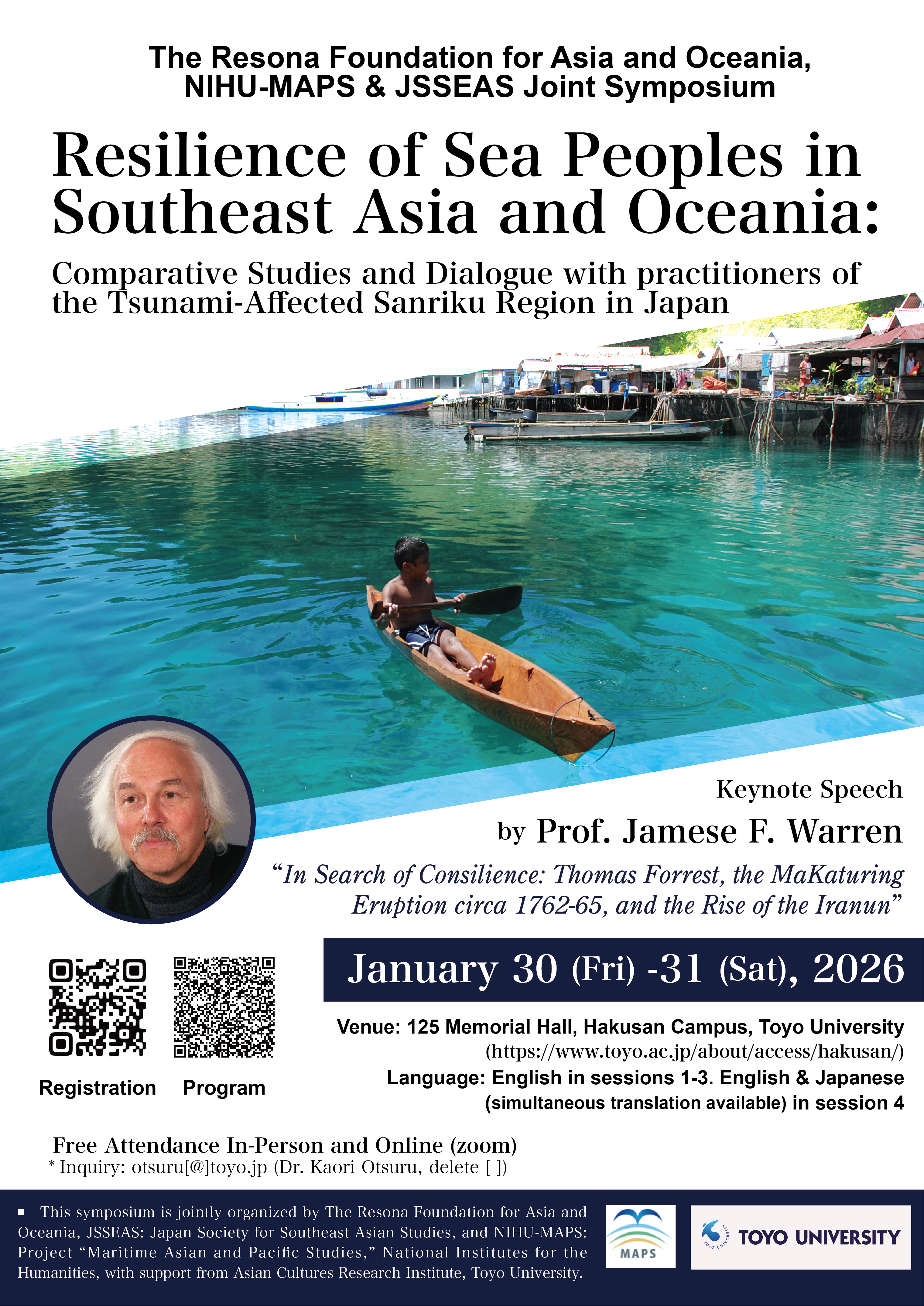
International Symposium Resilience of Sea Peoples in Southeast Asia and Oceania
2026.1.28
EnglishLatest NewsResearch
The Resona Foundation for Asia and Oceania
NIHU-MAPS & JSSEAS Joint Symposium
Resilience of Sea Peoples in Southeast Asia and Oceania:
Comparative Studies and Dialogue with Practitioners of the Tsunami-Affected Sanriku Region in Japan
Date: 30-31 January
Venue: 125 Memorial Hall, Floor 7, Building # 8, Hakusan Campus, Toyo University (https://www.toyo.ac.jp/about/access/hakusan/)
*The event will also be live-streamed online through Zoom
Language: English (Simultaneous Japanese-English translation will be available for session 4 on the second day.)
We are delighted to announce that we will host an international symposium titled “Resilience of Sea Peoples in Southeast Asia and Oceania: Comparative Studies and Dialogue with Practitioners of the Disaster-Affected Sanriku Region in Japan.” The symposium is jointly organized by the Resona Foundation for Asia and Oceania, NIHU-MAPS: National Institutes for the Humanities; JSSEAS: and Japan Society for Southeast Asian Studies, JSSEAS: Japan Society for Southeast Asian Studies, with support from ACRI: Asian Cultures Research Institute, Toyo University.
1月30日および31日の2日間にかけて、上記の国際シンポジウムを東洋大拠点にて開催いたします。対面・オンラインどちらの参加も可能です。使用言語:英語。ただし、2日目の第4セッションは日英同時通訳を介しておこないます。
*** PROGRAM (click for download PDF)***
*** SYNOPSIS AND PROGRAM (click for download PDF)***
*** REGISTER (click for Google Form)
*** Abstract (click for download PDF)***
Day 1: January 30, Friday
10:30-10:40 Welcome and Introductory Remarks
— Kazufumi Nagatsu (Toyo University)
Session 1 — Sea Peoples and Nature: Perspectives from the Next Generation
Chair and Moderator: Yuki Suzuki (Kokushikan University)
10:40-11:00 Was it a “Disaster”? The Experience of the Sama-Bajau People in Banggai Islands, Indonesia
— Makibi Nakano (Konan Women’s University)
11:00-11:20 From Home-seas to Urbanities: The State of the Sama-Bajaus across the Philippines amidst Socio-Ecological Changing Realities
— Amiel Jay Lopez (Ateneo de Davao University)
11:20-11:40 Political Ecology of Marginalization: Sea Nomad Resilience Against Coastal and Marine Extraction in Southeast Asia
— Wengki Ariando (KITLV: Royal Netherlands Institute of SE Asia and Caribbean Studies)
11:40-12:00 Living with Disasters: A Case Study of Guadalcanal, Solomon Islands
— Shin-ichi Fujii (National Museum of Ethnology)
12:00-12:15 — Break —
12:15-12:30 Comments — James F. Warren (Murdoch University)
12:30-13:00 Discussion
13:00-14:00 — Lunch —
14:00-14:40
Keynote Speech
In Search of Consilience: Thomas Forrest, the MaKaturing Eruption
circa 1762-65, and the Rise of the Iranun
Prof. James F. Warren (Murdoch University)
14:40-14:50 — Break —
Session 2 — Dynamics of Human-Environment Interactions among Sea Peoples
Chair and Moderator: Fujii Shinichi (National Museum of Ethnology)
14:50-14:55 Introduction — Fujii Shinichi
14:55-15:15 On Indigenous Resilience: The Orang Suku Laut
— Cynthia Chou (University of Iowa)
15:15-15:35 Boat as a Nexus Linking Maritime Societies and the Environment: A Case Study of the Moken in the Andaman Sea, Thailand
— Yuki Suzuki (Kokushikan University)
15:35-15:55 Perception of the Globally Changing Environment among Vezo Fishers of Madagascar
— Taku Iida (National Museum of Ethnology)
15:55-16:10 — Break —
16:10-17:00 Discussion
17:10-17:50 Business Meeting (MAPS members only)
18:10-20:00 Reception (advance registration required)
Day 2: January 31 (Sat)
Session 3 – Vernacular Meanings of Living on the Sea
Chair and Moderator: Hisashi Shimojo (Kobe University)
10:30-10:35 Introduction — Hisashi Shimojo
10:35-10:55 The Bajau’s Art of Not Being Subjugated in the Wallacean Sea
— Kazufumi Nagatsu (Toyo University)
10:55-11:15
Online Bajau Laut of Made Invisible via Institutionalised Knowledge Production about Social and Environmental Threats
— Fadzilah Majid and Greg Acciaioli (The University of Western Australia)
11:15-11:35
Online — The Origin of Lau and the Influence of Polynesian Outliers in the Solomon Islands: Reflections from Oral History
— Daisuke Takekawa (The University of Kitakyushu)
11:35-11:50 — Break —
11:50-12:40 Discussion
12:40-13:40 — Lunch —
Session 4 — Dialogue with Practitioners of the Sanriku Region: Resilience of Coastal Communities after the 2011 Tohoku Earthquake and Tsunami and its Implications for
Southeast Asia and Oceania
Chair and Moderator: Tsukiko Myojo (JSPS / Toyo University)
13:40-13:45 Introduction — Kazufumi Nagatsu
13:45-14:10 Seawall and Civic Engagement: A Challenge in Post-Tsunami Beach Recovery on the Oya Coast of Kesennuma
— Tomoyuki Miura (Project Rias, Kesennuma)
14:10-14:35 Community Resilience Beyond Seawalls: Post-Tsunami Recovery, Coastal Protection, and Environmental Conservation in Kesennuma-Moune
— Makoto Hatakeyama (NPO Mori wa Umi no Koibito, Kesennuma)
14:35-14:55 From Recovery to Resilience: Post-tsunami and Post-Covid Lifeways of the Moken in Thailand
— Narumon Arunotai (Chulalongkorn University)
14:55-15:15 Bridging Three Decades of Discourse and Reality: Community-Based Coastal Management in Maluku and Papua, Indonesia
— Dedi Adhuri (National Research and Innovation Agency, Indonesia)
15:15-15:30 — Break —
15:30-15:40 Comments 1 — Takuro Furusawa (Kyoto University)
15:40-15:50 Comments 2 – Hironao Kawai (Tokyo Metropolitan University)
15:50-16:30 Round Table Dialogue
16:30-16:45 Summary and Wrap-up
— Rintaro Ono (National Museum of Ethnology/ Leader, MAPS)
16:45-16:50 Closing Remarks — Kazufumi Nagatsu